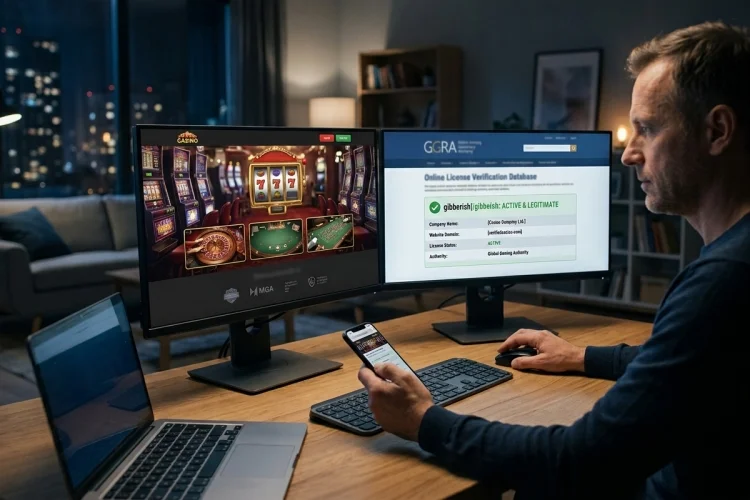
The most dangerous fake casino websites are not the ones that look terrible. They are the ones that look convincing enough to make people deposit before asking questions.
Understanding the Warning Signs of a Fake Casino Website means knowing what to verify before money or personal documents change hands.
A copied licence badge, attractive game library, professional homepage, or large bonus does not prove that the operator is legitimate.
Instead, look at the domain, company identity, withdrawals, payment demands, customer protections, and how the site behaves when you ask difficult questions.
Check the Domain Against the Regulator’s Records
A legitimate-looking casino name is not enough.
Start with the exact domain.
The UK Gambling Commission’s public register, for example, lets users search licensed gambling companies and associated domains. The register also shows whether a licence is active, expired, surrendered, revoked, or in another recorded status.
That makes domain matching particularly useful.
Imagine finding a casino called “Example Casino” at examplecasino-new....
Even if another domain with a similar brand name belongs to a licensed company, the new domain should not automatically be trusted.
Scammers can imitate brands much faster than most consumers verify them.
Always compare the exact web address.
A Search Engine Result Is Not Proof of Legitimacy
Many people assume the first website displayed by Google or another search engine must be official.
That assumption can create problems.
The FTC has warned that scammers can use paid search listings, familiar business names, and misleading contact information to direct users to fraudulent websites.
UK Gambling Commission research also found that search engines were one pathway through which respondents who had used illegal gambling websites discovered them.
This does not mean search engines themselves are unsafe.
It means ranking highly is not a gambling licence.
If you know the operator already, type its known address directly or locate the domain through the regulator.
Watch for Missing Identity and Age Checks
An online casino asking for basic identity information can feel inconvenient.
But absolutely no verification can also be a warning sign in regulated markets.
UK Gambling Commission research into illegal gambling found that gambling without identity or age verification was the most commonly selected potential indicator of illegal website usage among surveyed respondents, at 20%.
Missing deposit limits, self-exclusion, and other safer-gambling tools followed at 18%.
This does not mean every verification process is legitimate.
Fraudulent sites can also collect identification to steal personal information.
The question is whether identity checks are being conducted by a verifiable licensed operator through a secure and clearly explained process.
Never upload documents simply because a pop-up asks for them.
Verify the business first.
Be Suspicious of “Pay More to Withdraw” Demands
One classic scam pattern is turning a withdrawal into another payment opportunity.
You request your winnings and suddenly receive a message saying you must pay a tax, verification charge, wallet activation fee, processing fee, or additional deposit.
Treat unexpected demands carefully.
The FTC identifies urgent demands for payments and instructions to use hard-to-recover methods as common scam characteristics.
Legitimate gambling businesses can have stated transaction fees, currency charges, or verification requirements.
The difference is transparancy.
Those conditions should be disclosed in advance rather than invented after a successful withdrawal request.
Do not assume sending “just one more payment” will unlock your balance.
That is exactly how some frauds continue.
Withdrawal Rules Should Exist Before You Win
Open the terms before depositing and search for “withdrawal.”
You should be able to understand the basic process.
Questions worth answering include how withdrawals are requested, whether limits apply, which payment methods are supported, and what verification may be required.
Withdrawal delays alone do not prove fraud. Even regulated operators can experience legitimate compliance or processing issues.
However, vague or constantly changing conditions deserve caution.
The UK Gambling Commission has stated that operators should not introduce unnecessary friction at withdrawal when information could reasonably have been requested earlier. Withdrawal-related issues have also remained a prominent topic among consumer contacts.
A casino that can explain deposits in seconds should also be able to explain withdrawals clearly.
Fake Casinos May Copy Real Games and Branding
Seeing familiar-looking slots does not automatically prove that the website is authorised.
This is especially important because legitimate gaming content can appear in unauthorised environments.
In January 2025, the UK Gambling Commission issued an industry warning after identifying games supplied by licensed businesses appearing on unlicensed websites accessible to British consumers.
The regulator warned that illegal markets may expose users to fraud, privacy problems, inadequate safeguards, and unfair practices.
Therefore, recognising a popular game provider is not enough.
The operator itself still needs to be verified.
The same principle applies to regulator logos, responsible-gambling badges, payment icons, and security graphics.
Images can be copied.
Licensing records are harder to fake.
Bonus Terms That Make No Sense Are a Warning
Fake casinos often rely on excitement before scrutiny.
One effective tactic is offering an unusually large bonus with conditions buried somewhere else – or no meaningful conditions at all.
Look for wagering requirements, eligible games, maximum stakes, expiry periods, withdrawal rules, and maximum cash-out limits.
If the bonus promises guaranteed profits, instant riches, or “risk-free” gambling with no genuine conditions, be sceptical.
Another warning sign is when the rules change after you have met the original requirement.
Save copies of important terms when using any gambling promotion.
If a dispute later occurs, knowing exactly what was stated at registration can be useful.
A bonus should never be used as proof that a casino is trustworthy.
Poor Customer Support Can Reveal Bigger Problems
Try customer support before making a deposit.
Ask for the legal company name or licence information.
If the representative refuses to answer, changes the subject, pressures you to deposit, or becomes aggressive, leave.
Also look for a formal complaints procedure.
The UK Gambling Commission says businesses licensed under its framework must maintain fair, open, and transparent complaints policies. They must also have arrangements for eligible unresolved complaints to reach an Alternative Dispute Resolution provider.
A fake operator may have no formal complaints path because there is effectively nobody independent to complain to.
Live chat alone is not accountability.
Strange Messages Can Be Phishing Attempts
Sometimes the fake casino is not the website you originally joined.
Scammers can send an email, SMS, social-media message, or messaging-app notification pretending to represent a casino you know.
The message might claim:
Your withdrawal has failed.
Your account needs urgent verification.
A special bonus expires in ten minutes.
Your password must be reset.
The FTC warns that phishing messages often create a convincing story designed to make people click links and surrender passwords or financial information.
Do not use the link in an unexpected message.
Open the casino through a verified address instead.
If the alert was legitimate, you should usually be able to see the same information after logging in securely.
Fake Security Checks Are Becoming More Sophisticated
Not every “security verification” screen is genuine.
The FTC warned in 2026 about fake CAPTCHA scams that tell users to run keyboard commands under the guise of proving they are human. Those commands can install malware capable of stealing login or financial data.
A real CAPTCHA should not require you to open your operating system’s Run window, paste commands, or install software.
The same principle applies to casino websites.
Do not install unknown browser extensions, remote-access software, “verification applications,” or unusual files simply because support tells you to.
A casino account should not require you to compromise your device security.
Missing Player Protection Is More Than a Minor Detail
A trustworthy gambling website should provide more than a deposit button.
Look for account histories, spending or deposit controls where applicable, self-exclusion information, complaints procedures, and responsible-gambling resources.
The UK Gambling Commission advises consumers to check licences, terms, deposit rules, complaints policies, and customer-fund protections before gambling with an operator licensed in Great Britain.
Unlicensed websites may not provide comparable safeguards.
The absence of player controls does not independently prove fraud, but when combined with an unverifiable licence, unclear ownership, and suspicious payments, the overall picture becomes much more concerning.
Evaluate warning signs together rather than in isolation.
What to Do If You Think a Casino Is Fake
Stop sending money first.
Do not make another payment simply because support claims your balance will otherwise disappear.
If you reused your casino password somewhere else, change it.
Enable multi-factor authentication on important accounts where available.
If you entered card or banking information into a suspected phishing site, contact the relevant financial institution using verified contact information.
The FTC also recommends reporting phishing attempts and taking action quickly when personal or financial data may have been compromised.
Keep screenshots, payment records, emails, chat logs, and the website address.
Those records may be useful when reporting the incident.
The Warning Signs of a Fake Casino Website often appear before the first deposit: an unverifiable domain, missing licence information, suspicious payment demands, unclear withdrawals, fake security checks, and weak customer protection.
Slow down before entering financial details, verify the operator through an official regulator, and avoid unexpected payment or verification links. A convincing design is easy to create; independently verifiable information is far more valuable.