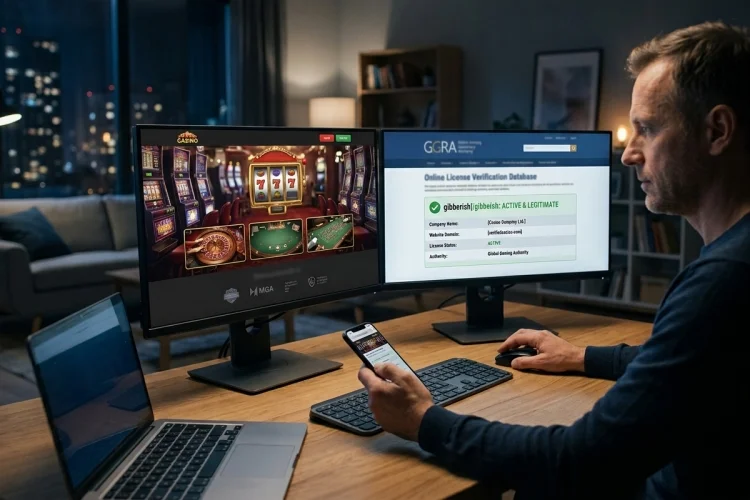
Seeing the words “licensed and regulated” on a casino homepage can create immediate confidence.
Yet those words are meaningful only when the claimed authorisation belongs to the correct company, covers the exact website, remains active, and permits the services being offered.
This practical issue explains why online casino licensing matters and why players should learn to verify it independently.
Scam websites can copy licence logos, registration numbers, company addresses, and even sections of terms from legitimate operators. A footer badge should never be accepted as complete proof.
A proper licence check does not require advanced legal knowledge. Players can compare the casino’s domain and company with an official regulatory register, confirm the licence status and activities, and inspect published warnings or enforcement decisions.
The process should be completed before depositing or uploading identification. It can quickly reveal whether the casino is operating under recognised oversight or merely using regulatory language as a marketing tool.
Check Whether the Licence Covers Your Location
Online gambling regulation is jurisdiction-specific. A casino may hold authorisation in one country without being permitted to market or provide services in another.
For example, an operator offering remote casino games to customers in Great Britain requires the relevant UK Gambling Commission licence, regardless of where the business itself is based.
Players should identify the regulator responsible for online gambling in their location. They should not assume that any international company registration or foreign gambling licence automatically provides local protection.
Where online casinos are prohibited or unavailable under local law, a foreign licence does not necessarily make participation lawful.
Find the Licence Information on the Casino
Start with the casino’s footer, terms and conditions, privacy policy, or “About” page. Record the stated regulator, licence number, operating company, registered address, and authorised trading name.
The company shown in the terms may differ from the public casino brand. This is normal when one licensed group operates multiple websites.
What is not normal is missing ownership information, conflicting company names, or a licence number that changes between pages. Statements such as “internationally approved” are not useful unless they identify a real authority and licence.
Take a screenshot or save the relevant page before proceeding to the external check.
Search the Regulator’s Official Register
Open the regulator’s website independently rather than clicking the casino’s licence logo. Search for the company, brand, licence number, and domain.
The UK Gambling Commission’s public register allows users to inspect licensed businesses and related details. Its licensing objectives are to prevent crime, ensure fair and open gambling, and protect children and vulnerable people.
The MGA also provides a Licensee Hub and publishes information about player protection. Its application process examines suitability, business planning, finances, and technical arrangements.
Use only the regulator’s genuine domain. Sponsored advertisements and imitation registers can lead to misleading pages.
Match the Exact Domain and Company
A valid licence belonging to another company does not protect the casino you are visiting. Compare the full domain carefully, including spelling and domain extension.
For example, examplecasino.com and example-casino.net are separate websites. A scam operator may copy a recognised brand while adding a hyphen, letter, number, or unfamiliar extension.
Next, match the legal company in the casino terms with the entity named in the register. Confirm that the licensed trading name and permitted activities include remote casino services rather than an unrelated gambling product.
When the register lists authorised domains, the website should appear exactly as entered in the browser.
Review Status, Conditions, and Enforcement
A licence may be active, suspended, surrendered, revoked, or expired. An operator may also be subject to special conditions or regulatory action.
Do not stop after finding a company with a similar name. Read the complete entry and check recent regulator announcements.
Licensing creates the possibility of enforcement when standards are breached. Regulators can examine areas such as customer treatment, anti-money-laundering controls, marketing, payment handling, technical compliance, and safer gambling procedures.
The UK Gambling Commission also publishes information about regulatory action through its public register and enforcement pages.
Past action does not automatically prove that a casino is currently unsafe, but repeated or serious breaches deserve careful consideration.
Compare the Protections Behind the Licence
Different regulators impose different standards. Players should investigate what the licence requires rather than ranking licences only by brand recognition.
Important areas include independent game testing, customer-fund arrangements, withdrawal transparency, age verification, responsible gambling tools, data security, and complaint handling.
UK remote operators are subject to technical and security requirements, while relevant games may need assessment by approved test houses.
The MGA states that player funds must remain separately identifiable under its player-protection framework.
These examples show how licensing can affect practical protections, although the exact rules differ by market.
Recognise Fake or Weak Licensing Claims
A questionable casino may display a licence logo that cannot be clicked, link to a generic regulator homepage, or provide a certificate image without a searchable record.
Other warning signs include hidden ownership, no physical business address, contradictory terms, no withdrawal policy, and no formal complaint route. Demands for an extra deposit or “tax payment” before releasing existing winnings are especially concerning.
A licence also matters less when the regulator has no authority over the player’s country or offers limited consumer recourse. Verification should consider both authenticity and relevance.
Never send identification or payment information while significant licence questions remain unresolved.
Online casino licensing matters because it connects a gambling website to identifiable ownership, technical rules, financial requirements, player safeguards, and possible enforcement.
However, the protection is useful only when the licence is genuine and applicable. Before registering, identify your local regulator, locate the casino’s legal information, and search the regulator’s official database.
Match the exact domain, company, status, trading name, and authorised activities. Review any conditions or enforcement history and examine the protections provided by that jurisdiction.
Do not let a large bonus or instant-deposit promise replace these checks. Verify first, read the withdrawal terms, set firm spending limits, and treat gambling as entertainment rather than income.
When licence information cannot be confirmed, do not deposit or upload documents.