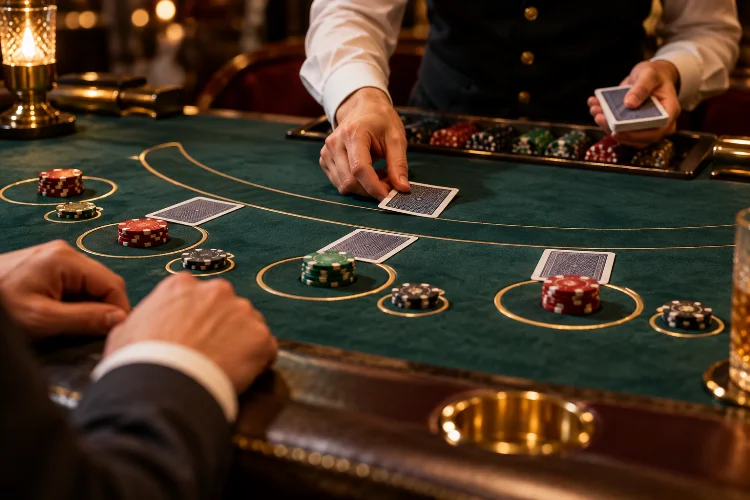
A side bet can transform an ordinary blackjack hand into something much more dramatic. Suddenly, two matching cards might pay 25:1, a three-card poker combination could trigger a large prize, or a dealer bust might produce a separate payout.
That excitement explains why optional wagers are so common. But Blackjack Side Bets Explained properly requires looking beyond the maximum prize.
The crucial details are probability, paytable structure, house edge, and how additional bets change total exposure. A side wager can be entertaining without being mathematically similar to the blackjack hand sitting beside it.
Why Side-Bet Payouts Look So Large
A blackjack main wager usually pays even money when you beat the dealer, while a natural blackjack commonly pays 3:2 under traditional rules.
Side bets can display much larger numbers: 10:1, 25:1, 40:1, or even 100:1.
The reason is rarity.
Imagine an event that appears very infrequently. A casino can offer a much larger prize because most rounds do not produce that outcome.
For example, in one eight-deck 21+3 structure, a suited three of a kind pays 100:1. Wizard of Odds calculates its probability at only about 0.0244%, or roughly one occurrence in several thousand hands under that model.
The big payout is therefore not free value.
It compensates, partially, for an event that happens rarely while the complete paytable still retains a house advantage.
House Edge Depends on the Exact Paytable
One of the biggest mistakes is asking, “What is the house edge on 21+3?” as though there were one universal answer.
There are many versions.
Wizard of Odds documents multiple 21+3 structures where the house edge varies significantly depending on payouts and deck count. One eight-deck version produces approximately 3.70%, while other versions can be considerably higher.
The same principle applies to Perfect Pairs.
An eight-deck 6-12-25 structure analysed by Wizard of Odds has a house edge of about 4.10%. Change those payouts and the expected return changes as well.
This makes a paytable more valuable than a marketing label.
Two casino lobbies can offer a button with exactly the same name but deliver slightly different mathematics underneath.
Perfect Pairs Shows How Prize Tiers Work
Perfect Pairs provides a good example because the bet often contains several prize levels.
Suppose your opening cards are two Kings.
If one is red and one is black, that may qualify for the lowest pair category. Two Kings of the same color could earn a higher payout. Two identical Kings of the same suit from a multi-deck shoe may qualify for the largest “perfect” prize.
One common eight-deck structure pays 6:1, 12:1, and 25:1 across those tiers.
This structure creates frequent enough lower-tier events to keep the feature visible while reserving the large headline payout for a rarer combination.
The important point is that your normal blackjack result is irrelevant to this settlement.
You could receive a pair, win Perfect Pairs, split the cards, and then lose both main blackjack hands. Every wager is evaluated seperately.
21+3 Demonstrates Why Frequency Matters
Consider an eight-deck 21+3 version where your first two cards and the dealer’s up card can form poker combinations.
The analysed probabilities show that ordinary straights and flushes happen far more frequently than suited three-of-a-kind results. The payouts reflect that difference.
Suppose your cards are 8♠ and 9♠ while the dealer shows 10♠.
That creates a straight flush for the side bet, even though your blackjack hand is simply 17.
Alternatively, 8♠, 9♥, and 10♣ creates a straight without the matching suits and normally falls into a lower payout category.
This illustrates the basic relationship:
rarer combinations generally need larger payouts to attract the wager.
However, the payout does not have to be perfectly “fair.” The difference between true probability and offered payment is where the casino’s expected advantage comes from.
Hot 3 Uses Blackjack Totals Instead of Poker Hands
Hot 3 feels similar to 21+3 because it uses the same three cards, but its logic is different.
Your first two cards and the dealer’s up card are combined according to blackjack card values. Common winning categories include totals of 19, 20, and 21.
Higher-paying outcomes include suited 21 and three sevens.
In an eight-deck analysis, Wizard of Odds calculates approximately 5.40% house edge for the published structure, with three sevens paying 100:1 and suited 21 paying 20:1.
That is useful for comparison.
Two side bets can use exactly the same three physical cards but produce totally different results because their qualification rules are different.
Reading only the payout button without understanding the mechanic can therefore be misleeding.
Insurance Shows That Familiar Does Not Mean Cheap
Insurance appears so naturally in blackjack that some players do not think of it as a side bet.
But mathematically, that is exactly what it is.
When the dealer shows an Ace, insurance wagers that the hidden card has a value of ten. It usually pays 2:1 when correct.
For a standard single-deck game without additional card-composition information, Wizard of Odds calculates the insurance house edge at about 5.9%.
In multi-deck games, the exact number depends on how many ten-value cards remain relative to other cards.
The lesson is broader than insurance itself.
A wager can sound protective while still carrying its own expected cost. The emotional purpose of a bet and its mathematical structure are two different things.
Side Bets Can Multiply Your Total Action
Consider a player making a $10 main blackjack wager.
They also place $5 on Perfect Pairs and $5 on 21+3.
Their total initial exposure is now $20 rather than $10.
If they play 50 rounds and make the same three wagers each time, $500 has gone through the main blackjack bet and another $500 through the two side bets.
That does not equal a $1,000 loss. Some bets will win and return money.
What has doubled is the amount being wagered before later blackjack actions are even considered.
A double down or split can push total round exposure higher again.
This is why side bets can change the financial character of a session far more than their small chip values initially suggest.
Main Blackjack and Side Bets Have Different Mathematics
A well-structured blackjack main game played using appropriate basic strategy can carry a relatively small house edge.
Optional bets often operate differently because they are built around rarer combinations and higher payouts.
That does not automatically make them “bad” products. They simply serve a different entertainment purpose.
A side bet adds suspense to the opening deal and creates the possibility of a comparatively large return from a small wager.
The trade-off is usually a higher mathematical cost.
This makes comparison important.
Do not see a $5 side bet as harmless merely because it is smaller than your $20 main wager. Compare its house edge and how frequently you intend to place it.
Repeated small bets can accumulate quickly.
Dealer-Bust Bets Show Why Rules Matter
Dealer-bust wagers seem straightforward: you win if the dealer exceeds 21.
Yet even these bets can vary considerably.
One Buster Blackjack paytable analysed with six decks and the dealer hitting soft 17 produces a calculated house edge around 6.21%. Other paytables and soft-17 rules produce different percentages.
A completely different “Bust” structure analysed by Wizard of Odds can have much lower house edges depending on deck count and dealer rules.
So the statement “dealer bust side bets have X% house edge” would be inaccurate without specifying the version.
The same caution applies across the entire side-bet category.
Names describe concepts. Paytables define the actual bet.
How to Evaluate a Side Bet Before Playing
Start by opening the game rules rather than looking only at the maximum prize.
Check which cards determine the result, every qualifying combination, the payout for each one, and whether the number of decks is stated.
Next, look for RTP or house-edge information where available.
UK Gambling Commission technical standards require relevant information about rules, prizes, RTP, house edge, or winning probabilities to be accessible before customers commit to play.
Finally, compare the extra wager with your total planned spend.
A side bet should not become a reason to increase an entertainment budget simply because the interface presents a rare 100:1 prize.
Those large numbers are exciting precisely because the winning events are uncommon.
With Blackjack Side Bets Explained mathematically, the most important lesson is that payout size alone tells only half the story. Probability, deck count, paytable, and house edge determine what the wager really offers.
Compare each side bet separately from the main blackjack game and include it in your total stake. If you choose to use one, treat the extra wager as entertainment rather than a way to improve blackjack’s underlying odds.